|
 GEOGRAPHICAL
REPARTITION OF THE POVERTY GEOGRAPHICAL
REPARTITION OF THE POVERTY
A rural Andean area...
The Parish of Calpi is situated in the Andean region. It is formed of
19 native communities. So, it is a rural area, the rural space of the
country mostly turning around the communities.
...Situated in one of the poorest provinces of the country
On the national scale, poverty is principally found in rural areas, and
more specifically in the rural area of the Sierra (74.5% of the poor),
that is the native communities. Besides, the province of the Chimborazo
is the second poorest province of Ecuador, having 81% of the poor.
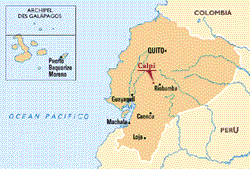
Thus, poverty is particularly high in a Parish like the Parish of Calpi.
The Parish of Calpi is composed of 19 native communities, which represent
around 18,000 people. The population is composed of natives, most of them
are farmers. The population is young, following numbers than on the national
level (49.5% of the population are less than 20 years old)

ECONOMY
93% of the inhabitants own their own house, their lands of modest size
and some cattle. With its present functioning, the familial agricultural
activity in the communities is not financially viable. The effects of
the economic crisis in the country add further to the situation. Consequently,
a perceptible migration of the workingmen towards the cities can be noticed:
looking for a better-paid job particularly in the building industry. In
those conditions, the agricultural work is principally done by children
and women, and the elderly (there is no retirement for the agricultural
workers).
INFRASTRUCTURES
AND HOUSES
Most of the houses are permanent structures (breeze-blocks, bricks),
have drinking water (what is extremely rare in native communities) and
a draining system. Few houses have toilets. The streets are made of earth
and are damaged after each rain. There are only 5 phone and electricity
wires.
In the geographical area of San Francisco, children under nourishment
affects 40% of the children under 5 (against a national average of 38%).
SANTE
Infant mortality is considerable. It is over represented in the province
of Chimborazo with a rate of 100‰ (46‰ nationally). Most of
the time they suffer from infectious, contagious and parasitic diseases,
from severe breathing insufficiency in 31% of the cases, from severe diarrhoea
in 9% of the cases, from infant under nourishment.
There are various reasons. The population has scarce access to medical
care: the social security is very expensive and so is not available to
the poorest. Other reasons are the lack of hygiene, the not nearly enough
health education programmes, the insufficient sanitary structures, the
fact that in 50% of the houses about 3 people sleep in a the same room,
and that there is no rubbish collection.
EDUCATION
The educational system in the native communities is very bad, and receives
little support from the state. In terms of education, the province of
Chimborazo is the one where the number of illiterate people is the highest:
40%. The native populations are particularly touched by this phenomenon.
Frequently, children do not finish the third level of basic education
and start to work in the fields or in the cities.
Now, the 19 communities of the Parish of Calpi, among which San Francisco
of Cunuguachay, have a kindergarten (children aged 4 to 6) and a school.
Yet, the school only has 1 or 2 teachers for the whole grades.
|
