Health | Education | Meat Factory | Delicatessen Factory | Jam Factory | Wooly jumpers Factory | House of Tourism
|
Since 2000, nutrition courses are given for free to women of the 19 communites
of Clapi parich. The goal of this project is to improve the population
food and, therefore, its health. |
||
| It deals in : | - Educating mothers to the preparation
of quotidian equilibrated menus. - Improving the use of the communities fields products to create a variety of the food. - Creating scolar and familial gardens to enrich the quality of the primary materials - Sensibilizing parents to their Children health - Discreasing denutrition and illnesses caused by a bad alimentation |
|
|
After 3 years of courses, the situation is far better and the students never miss a lesson. But to definetly change the established way to cook, a long term work is fundamental. For more information, click here (spanish version only).
|
||
|
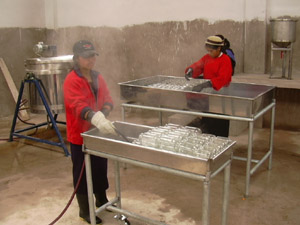
Identity Identity of the project The project was born in 2000 at the time of meetings achieved by the indigenous communities of Calpi, to analyze the economic and social impact of dollarization of the Ecuadorian economy (intervening in January 2000), and to find solutions to decrease the effect of it. The project of the meat factory was undertook thereafter by the community of San José of Gaushi first with the improvement of the pork quality, which the members of the community agreed to manage and provide. Then, with the technical support of sister Lucia Laiz, the meat factory could be opened, creating direct and indirect employment in the community. Future of the project At the present hour, 6 individuals work in the meat factory, which disposes
ofS adapted material for such a production. |
 |
|
|
The meat factory shows a good profitability, which is going to increase by the measure of its product improvement and by the constant formation of its personnel and automization.
|
||
|
Products : Chorizo fresco (Fresh Sausage), Chorizo curado(Cured Sausage ), Lomo, Salchichon (Sausage), Jamon curado (Cured ham) Products are manufactured according to the traditional Spanish recipe: the personnel have been trained by a Spanish specialist, learning the authentic manufacturing process thus explaining the quality of their products. For more information, consult our products rubric The manufacturing process Products are elaborated from beginning to end in San José of Gaushi,
from the raising of pigs until their conditioning and this thanks to the
personnel's expertise. |
 |
|
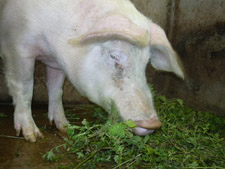
| Origin of pigs | The fact that the raising of pigs takes place in the same community guarantees the origin and the quality of products, all the while consolidating the production and participation of the community as a whole. | |
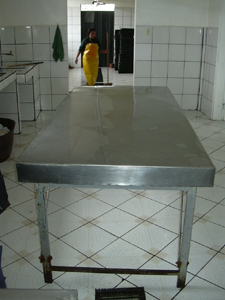
| Hygiene, a golden rule | The infrastructure has been known to
respect hygienic norms that are present throughout the manufacturing process:
constant cleaning of the production areas, clothes and adapted work tools.
Finally, the meat factory disposes of all the necessary materials to preserve
the products. |
|
| Selection ingredients | To elaborate products of quality that
correspond to the market demand, the ingredients used are solely natural,
selected with a lot of attention. The pimiento used to manufacture the sausage
comes from Spain. |
|
|
The experience of the craftsmen guarantees the high quality of our products.
Origin of the project If most communities of Calpi have irrigation problems, this
is not the case for la Merced of Guiltus, which, since 2002, finds itself
next to a river and has an effective irrigation system thus providing
excellent pastures for its cows. |
||
| A shared gain | Creating an economic micro-system, the
local milk producers are involved in the cheese factory selling their milk
at an equitable price that is not dependant on market fluctuations. |
|
| Resources created | 4 jobs, a new infrastructure containing
the suitable equipment for cheese production |
|
| Capacity of production | 500 liters of milk per day | |
|
Future of the project To obtain better economic results, it is important for the cheese factory to develop a wider client-consumer base, to improve the quality of its cheeses, and to create new products adapted to market demands. Products Thanks to the experience of our cheese-makers, we now produce 3 types
of cheeses each having different production requirements and results thus
responding to customer demand. |
||
| Queso fresco (Fresh cheese): | very hurried cream cheese, containing very little small milk and an adapted quantity of salt. | |
| Mozzarella : | this cheese has a soft texture and is
produced according to an Italian manufacturing process. Ideal for pizzas,
burritos and other Mexican dishes as well as salads. |
|
| Andino : | one month of refinement is needed for this cheese of semi-hard texture, typically highlander. | |
|
The manufacturing process
|
||
| The initial professional training |
The initial professional training period exists to give our micro-enterprise
the possibility to produce cheeses of quality, our priority is the formation
of the cheese-makers whose daily work constitutes the value added of our
products. Thus, the Ecuadorian professionals whose experience is not to
be questioned have trained them. |
|
| The quality of milk | All the milk used for the cheese production
comes from the local cow production in Guiltus. A strict control is done
every morning during the milk recollection: verification of the temperature,
the density and the acidity of the milk so that the final products meet
the high-quality requirements expected from our customers. |
|
| Hygiene | The initial formation period allows our
cheese makers to realize the crucial importance of hygiene in a dairy factory.
Hygiene takes up a huge part in the cheese maker's work, from the collection
of milk up to the refinement of the cheeses. Constant cleaning of the building and of the materials made of rustproof metal also meet the norms and hygiene requirements. |
|
| Cheese refinement |
The mozzarella and cream cheeses mature in less times that the andino
cheese, which must remain 1 month in our cellar before reaching maturity. |
|
|
Origin of the project
|
||
| Protection from market instability. | This micro enterprise project of making
jam was initiated by the same community members the same who value the community's
carrot production. Indeed, the inhabitants of San Francisco of Cunuguachay cultivate carrots in large quantity, but have problems merchandising them because the market prices are very unsteady. The price of a bag containing 50 kg of carrots can lower by 100% in less than one month. The project of a jam factory allows the community to buy from the farmers the carrots at a fair and steady price. |
|
| Implication and formation | Natives have been involved in this project
since its very beginning: construction of the factory, formation during
6 months. |
|
| Guarantee of quality |
A French engineer passed on the necessary technical knowledge to the
factory workers in order to guarantee the best possible product quality,
and studied every stage in the production process in order to assure that
there were not any contamination risks. |
|
| Solidarity between communities |
Not only are carrots bought from our neighboring indigenous communities, but also so are blackberries and strawberries so that this project benefits all. |
|
|
The products We sell products of the following flavor combinations: - Carrot-guava, carrot-orange, carrot-passion fruit: exotic flavors mixed
in with carrot: a treat.
This project is the initiative of the women's group of Rumipamba, to create and to value a local artisan production. The production that is about to begin shortly will have the advantage of creating alternative income sources allowing the families in the community to improve their living conditions. |
||
| An equitable export | These hand woven wool sweaters of high quality will be able to be sold not only in Ecuador, but also in other countries (Europe, North America...) | |
|
Origin of the project This eco-tourism project was born in 2000 with the initiative of a women's
group in the community of San Francisco of Cunuguachay. The goal: to produce
alternative income sources than those already existent, which are actually
insufficient. This project has also been conceived with the idea of having
an intercultural exchange opportunity mainly giving visitors a way to
discover the indigenous culture, and vice-versa, getting the community
to know another reality through contact and warm exchanges with foreigners.. |
||
| A shared gain |
The house of tourism welcomes visitors regularly all year round. The
project is profitable and represents a very important income source for
the women's group. |
|
| Direct job creation | a house administrator, 6 native tourist
guides, a cook for the weekends, and a person in charge of washing the linen.
|
|
| Indirect job creation: | purchase of community products (cheese,
milk, vegetables, potatoes etc), taxicab drivers are in charge of getting
the visitors access to Riobamba or to other tourist areas. |
|
|
Success measures - A feasibility and viability survey and study of the project. For more information, please visit our Tourism
pages |
||
 |
 HEALTH
: Nutrition projects
HEALTH
: Nutrition projects